

Company News
Inside Flags Factory’s Quality Control Process for Durable Printed Flags
Sep
Inside Flags Factory’s Quality Control Process for Durable Printed Flags
When a customer orders a printed flag, they are usually picturing one moment: the flag flying outdoors, colors reading clearly, edges holding straight. What they do not see is the chain of checks that has to happen before that moment is possible. At Flags Factory in Weifang, Shandong, quality control is not a final gate at the end of production — it is a sequence of decisions, inspections, and sign-offs that follows every order from fabric roll to shipping carton.
This article walks through that sequence step by step, so buyers — whether ordering a single custom banner or a recurring batch of national flags — understand what “quality control” actually means in practice.
Why QC Matters More for Printed Flags Than for Many Textiles
Flags live outdoors. They take wind load, sun exposure, rain, and constant flexing at the fly end and along the hoist. That means quality control has to focus on three things at once:
- Color consistency — what gets approved on a digital proof should match what arrives in the box.
- Structural integrity — hems, seams, and attachment points must survive repeated tension.
- Print cleanliness — sharp edges, no bleeding, no streaking, no ghosting from a misregistered screen.
A flag that looks right but is sewn poorly will fail outdoors. A flag that is sewn well but printed badly will fail on appearance. QC has to cover both.
Stage 1: Incoming Fabric Inspection
Every production run starts with the raw fabric. Our receiving team checks incoming rolls for:
- Weave consistency — visible slubs, thin spots, or uneven warp/weft density are flagged.
- Hand feel and weight — knit polyester, woven polyester, and spun fabrics behave differently under sublimation and screen printing, and each order is matched to the right base cloth.
- Surface defects — oil marks, creases, holes, or edge damage.
- Roll continuity — damaged or spliced sections are cut out before printing rather than printed over.
Rejected rolls are set aside and logged. Nothing moves to print until the fabric passes.
Stage 2: Artwork Preflight and Color Planning
Before ink touches cloth, the artwork goes through a preflight review. This is where most color problems are prevented rather than corrected. Our team checks:
- Resolution and vector integrity at the flag’s actual finished size
- Correct color mode and any customer-supplied color references
- Bleed and safe margins, especially for flags with borders or fringe
- Symmetry for two-sided printing, so the reverse reads correctly
For customers who need a close color match, we work from physical references and produce a strike-off or proof for approval before the full run. That approval becomes the reference standard for the entire order.
Stage 3: Press Setup and First-Article Approval
Once a job is scheduled, the press is set up and a first article — one complete flag — is produced and inspected. The first article is checked against the approved proof for color, registration, ink density, and print sharpness. Only when it is signed off does the rest of the run proceed. If the first article misses, we adjust the setup rather than printing the batch and sorting it later.
Stage 4: In-Line Printing Checks
During the run, operators pull samples at regular intervals. For dye-sublimation transfers, that means checking transfer paper for image integrity and watching for banding or dropouts. For screen printing, it means checking registration between screens, ink viscosity, and squeegee pressure. Any drift triggers a stop-and-reset rather than a “fix it in finishing” decision.
Stage 5: Curing and Ink Fixation
Ink that is not properly cured is the root of many durability complaints. Temperature, dwell time, and pressure are monitored on the calendar or heat press, and operators verify that fabric exits flat, dry, and free of surface tackiness. Cured panels are handled with clean gloves and kept off damp floors to avoid contamination before sewing.
Stage 6: Cutting, Sewing, and Finishing
Printed panels move to the sewing floor, where the checks shift to construction:
- Panels cut to the approved dimensions, with tolerance checked against the order sheet
- Fly-end hems folded and stitched with the correct number of rows for the flag’s size
- Seams at the hoist reinforced, since this is where wind stress concentrates
- Thread color matched, tension checked, and loose threads trimmed
- Header tape or sleeve sewn straight and centered
Stage 7: Hardware and Attachment Points
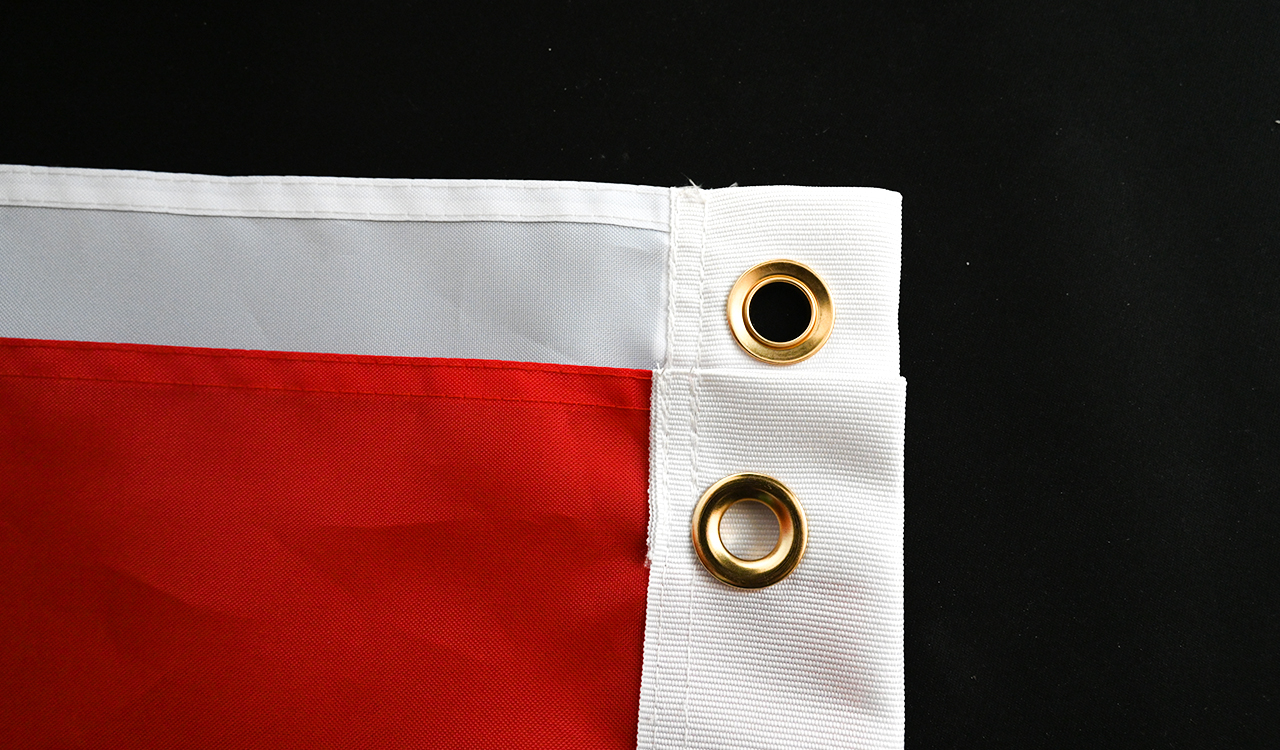
Grommets, rope, toggles, and rings are checked for placement, spacing, and seating. Grommets should be set cleanly into the header without cutting or crimping the fabric, since a torn grommet hole is a common cause of early flag failure. Metal hardware is inspected visually for burrs or sharp edges that could abrade the cloth.
Stage 8: Final Inspection and Batch Sampling
Finished flags go through a final inspection covering print quality, stitching, dimensions, hardware, and overall cleanliness. Larger runs are sampled at set intervals across the batch so that we inspect the whole run, not just the flags on top of the pile. Each order is logged with its inspection results.
Stage 9: Packing and Shipping Prep
Flags are folded consistently, protected from moisture and abrasion, and packed with the correct quantity per carton. Labels and packing lists are verified against the order before sealing. For B2B buyers with recurring programs, we keep the approved proof and construction notes on file so the next order is built to the same standard.
What This Means for Buyers
Good quality control is mostly invisible — you notice it only when something goes wrong, and it doesn’t. For customers ordering durable printed flags, the practical takeaway is simple: ask about fabric inspection, proofing, curing, and finishing checks. A supplier who can describe those steps clearly is a supplier who has thought about what happens to your flag after it leaves the factory.
If you’d like to discuss specifications, proofing, or a sample before placing a bulk order, our team at Flags Factory is happy to walk you through the process.
