
Company News
OEM ODM Flags Explained: How Custom Artwork and Private Labeling Cooperation Works
Oct
If you sell flags under your own brand — as a distributor, promotional products agency, event supplier, or online retailer — you do not need your own print floor to build a flag line. You need a manufacturing partner who can take your artwork, produce to your specification, and ship the finished goods with your name on the label instead of theirs. That is exactly what OEM and ODM cooperation is designed to do. This guide explains how the process works for OEM ODM flags, what happens to your artwork at each stage, and how private labeling turns a generic flag into a branded retail item.
OEM vs. ODM: Two Different Starting Points
The two models are often mentioned together, but they begin in different places.
- OEM (original equipment manufacturing) — you supply the design. You bring the artwork, dimensions, fabric choice, finishing details, and packaging requirements, and the factory builds to your brief. The product is yours; the factory is the production capacity behind it.
- ODM (original design manufacturing) — you start from a design or construction that already exists, such as a standard national flag size, a common feather banner shape, or a blank dye-sublimated layout. You then adapt it with your colors, artwork, and branding, and it is manufactured under your label.
OEM suits buyers with in-house design resources and firm specifications. ODM suits buyers who want to move quickly, test a category, or fill a catalog with proven formats while still shipping product under their own brand. Many programs combine both: an ODM construction base with OEM-level artwork and packaging.
The Cooperation Workflow, Step by Step
1. Brief and artwork intake
You share the finished flag size, quantity, intended use (indoor display, outdoor pole, handheld, retail resale), fabric preference, print method, and packaging plan. Artwork arrives as vector files, or as raster files at a resolution suitable for the final print size. We confirm what is usable and flag anything that needs redrawing before quoting.
2. File preparation and digital proofing
Artwork is scaled to the finished size with allowance for the pole hem, fly hem, and any grommet or sleeve placement, so no important element disappears into a seam. You receive a digital proof showing layout, orientation, and color references for approval. Nothing goes to print without written sign-off.
3. Sampling
For new constructions or tight color requirements, a pre-production sample lets you check fabric hand, print sharpness, stitch placement, and label position in your hands before committing to a bulk run. Photo proofs are a faster option for repeat orders where the construction is already established.
4. Bulk production and in-line checks
Once approved, the order moves to printing, cutting, sewing, and hardware attachment. Checks happen at print output and again at finishing, before goods are folded and packed.
5. Private label finishing
Labels, tags, and packaging are applied at the end of the line, which is why they need to be specified early rather than added at the last minute.
6. Packing and shipping
Cartons are marked to your requirement, and shipping terms are agreed in advance — whether you collect from the port, work through a forwarder, or ask for door delivery.
Custom Artwork: What Actually Matters
Most artwork problems are avoidable at the intake stage. A few practical points:
- Send editable vector files where possible; provide raster artwork large enough for the print size rather than a small web image scaled up.
- Convert text to outlines, or send the fonts along with the file.
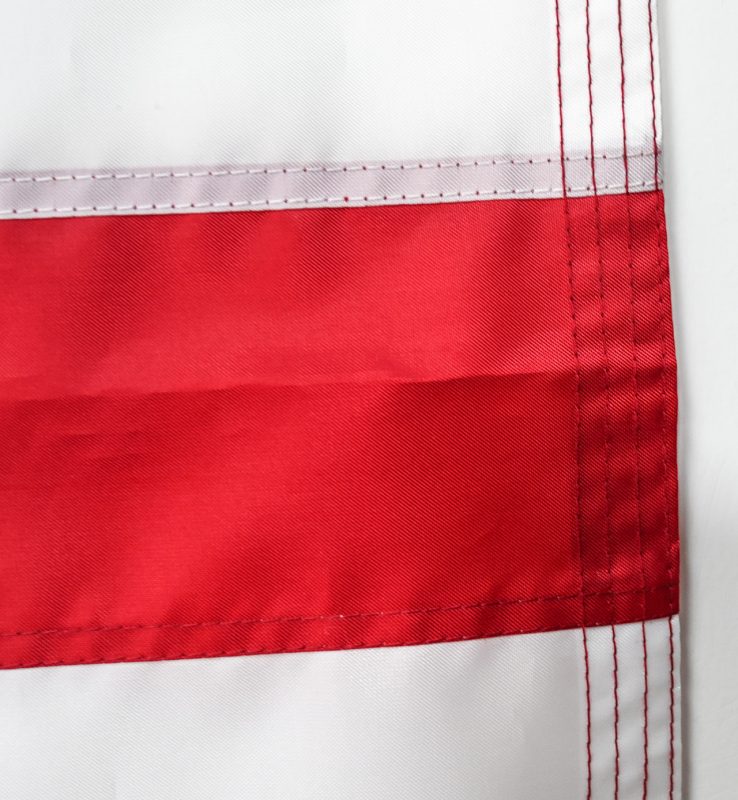
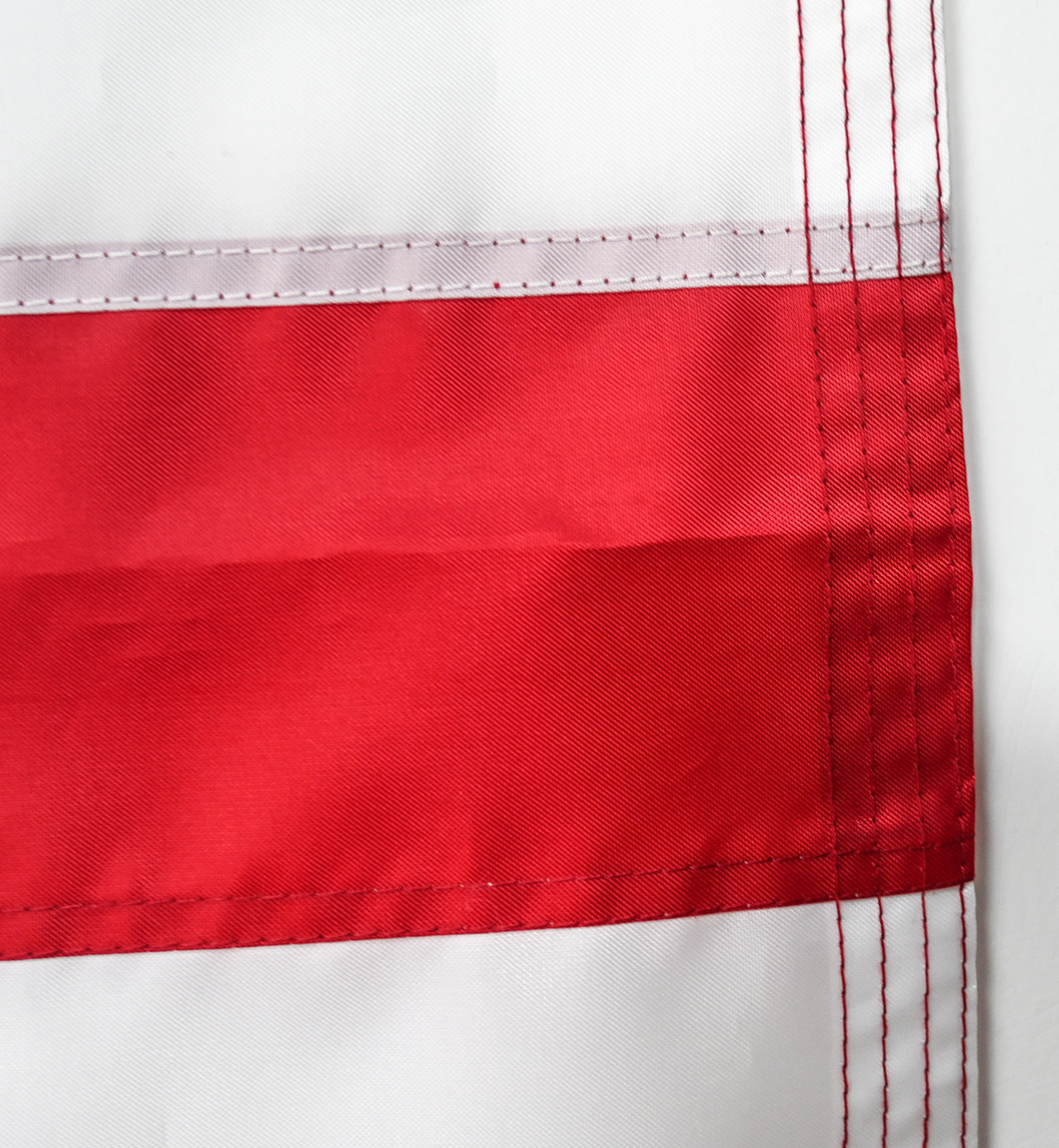
- Reference colors by a standard matching system, and accept that fabric and ink behave differently from a monitor — a physical sample is the reliable reference.
- Keep critical elements inside the safe area, away from hems and grommets.
- For double-sided flags, confirm whether the reverse should read correctly (a second printed layer) or mirror the front (a show-through construction).
Print method follows the design: dye sublimation for full-color photographic artwork, screen printing for solid spot colors on larger runs, and digital printing for short runs and detailed gradients. We will recommend one based on your artwork and quantity rather than defaulting to a single process.
Private Label Flags and Custom Flag Branding
Private labeling is what separates a wholesale flag from a product that carries your brand. Typical options include woven or printed neck labels, header cards, hang tags with your SKU and barcode, printed poly bags, branded inserts, retail-ready multipacks, and export cartons printed with your logo and handling marks.
Custom flag branding can go further than the label. Header cards can carry sizing and care information, packaging can be designed for pegboard or shelf display, and product photography support can be arranged for your listing. If you resell through marketplaces, we can pack to the barcode and carton labeling rules your channel requires — you supply the codes, and we apply them.
For buyers who want speed, an ODM approach with private label flags is often the shortest route: choose an established construction, apply your artwork and label, and launch without a full development cycle.
Artwork Ownership and Brand Protection
Before production, we ask for written confirmation that you hold the rights to any logo, trademark, or licensed design you send. Your files are used for your order and are not resold or reused for other customers. Where a project involves custom tooling or a dedicated construction, retention arrangements can be agreed in writing. A mutual non-disclosure agreement is available on request.
MOQs, Pricing, and Timelines
Minimum order quantities depend on construction, print method, and finishing rather than a single flat number, so quotes are prepared per project. The same applies to lead time: sampling rounds, artwork revisions, and packaging complexity all affect the schedule, and confirmed dates are given with the order confirmation rather than estimated in advance.
What to Prepare Before Requesting a Quote
- Finished size and quantity per design
- Artwork files, or a clear reference image for ODM adaptation
- Intended use and expected display environment
- Fabric and print method preference, if you have one
- Label, tag, and packaging requirements with artwork
- Barcode, SKU, and carton marking details
- Destination and preferred shipping terms
Send those details together and the quotation process becomes a single exchange rather than a long back-and-forth. Whether you are developing a fully custom OEM flag program or adapting an existing construction for a fast private label launch, the same principle applies: settle the artwork, the specification, and the branding early, and production becomes predictable.
Email: flagswin@flag-win.vip
WhatsApp: +86 13031678795
Facebook: https://www.facebook.com/StarFlagFactory/
Alibaba.com: https://wfqyflag.en.alibaba.com/
